
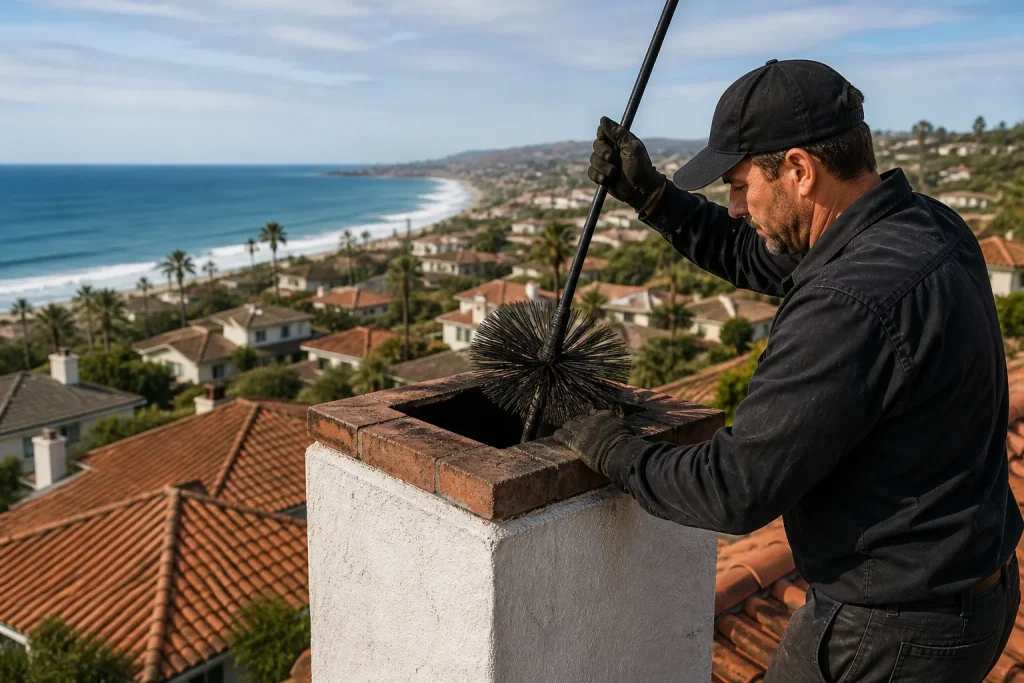
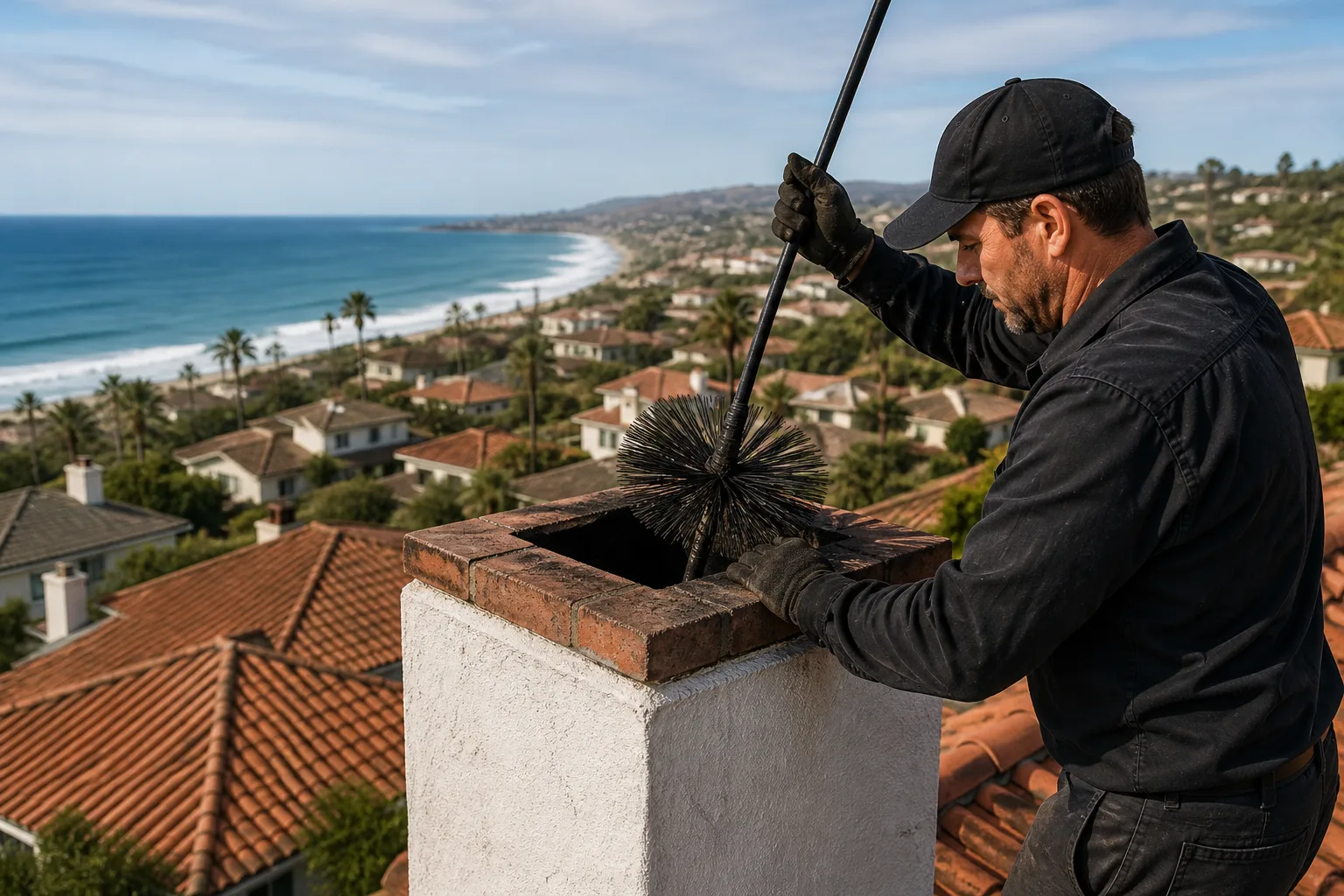
DuraFlex Chimney Sweep in San Clemente: A Homeowner’s Guide
DuraFlex is a flexible stainless steel liner system used to reline a masonry chimney whose original clay tile flue has cracked, spalled, or been sized wrong for the appliance attached to it. It is not a cleaning product and it is not a repair you schedule on a hunch. The mistake we run into most in San Clemente is a homeowner agreeing to a full DuraFlex reline before anyone has shown them the actual defect on camera. A liner decision should follow evidence, not a sales pitch. If you’d rather leave the diagnosis to a specialist, call (833) 509-5558 and we’ll take a look before anyone quotes you anything.
What Exactly Is a DuraFlex Liner System?
DuraFlex is a flexible, corrugated stainless steel flue liner. It arrives as a continuous coil, gets pulled down through the existing chimney chase, and connects your firebox to the top of the stack. Because it flexes, it can follow the slight offsets and bends that most masonry chimneys have inside, which rigid stainless sections can’t always navigate without cutting into the structure.
The liner does two jobs at once. It contains the smoke and combustion gases so they vent up and out rather than leaking through cracks in the surrounding masonry, and it protects the chimney structure from the heat and acidic moisture those gases carry. A cracked clay tile flue fails at both. Gases escape into wall cavities, and creosote and moisture work into the brick.
DuraFlex systems are rated for specific appliance types, and the rating matters. A liner matched to a wood-burning fireplace is not automatically the right liner for a wood stove insert or a gas appliance. The material grade, wall thickness, and insulation requirements change with the fuel and the heat output. When we specify a DuraFlex system, we’re matching it to what’s actually connected at the bottom of the flue, not grabbing whatever’s on the shelf. That’s the difference between a liner that performs and one that has to be redone.
Why San Clemente Chimneys Are Strong Candidates for Liner Failure
San Clemente’s mild winters mean the fireplace gets a workout in the cooler months without the deep freezes that dominate inland and mountain conversations. That’s actually part of the problem. A chimney here cycles between hot fires and cool, damp nights repeatedly through the season, and that thermal movement stresses mortar joints and clay tiles over time.
The bigger factor is the salt air. Homes close to the beach in neighborhoods like Pier Bowl, T-Street, and the streets above North Beach sit in an environment where airborne salt accelerates the breakdown of mortar and metal components. We see pitted mortar crowns, rusted dampers, and flue tiles with surface spalling at a rate that surprises homeowners who assume a mild climate means a low-maintenance chimney. Salt doesn’t care that it never snows here. It works quietly on the masonry and the metal hardware between fires.
The practical takeaway for San Clemente homeowners: don’t assume a young-looking house has a healthy flue. Age of the structure tells you very little. An inspection tells you everything. Homes near the coast deserve a closer look at the mortar and the flue interior, and homes slightly inland are not immune either once the chimney has seen a few decades of heating cycles.
DuraFlex, HeatShield, or a Rebuild: How the Right Fix Gets Chosen
This is where a lot of money gets spent in the wrong direction. A DuraFlex reline, a HeatShield resurfacing, and a full chimney rebuild are three different tools for three different problems. Getting the diagnosis right is the whole game, and it comes down to what the inspection finds inside the flue.
Here’s how the decision usually breaks down:
- HeatShield resurfacing fits a flue that’s deteriorated but structurally intact. The clay tiles have gaps, cracks, or a rough interior, but the chimney’s shape and integrity are sound. HeatShield is a specialist repair that restores the flue lining without tearing anything out, and many general sweeps simply can’t offer it. When it fits, it’s the least disruptive path.
- DuraFlex reline fits a flue that’s cracked through, badly spalled, or undersized for the appliance. If the clay can’t be reliably restored, a stainless liner inside the existing chase gives you a continuous, sealed flue wall. It’s the right call when the original tile is beyond resurfacing or when you’ve added an insert that needs a properly sized flue.
- Full rebuild fits a chimney with structural failure: leaning stack, failed crown letting water pour in, crumbling brick below the roofline. No liner fixes a chimney that’s coming apart around it.
The inspection criteria that drive this are the condition of the flue tiles (cracked, spalled, or missing), the presence of offsets or damage that would prevent a liner from seating, the appliance’s BTU load against the flue’s cross-section, and the total flue height. A proper chimney repair plan starts with those facts, not with a product name. We follow industry-standard inspection practices precisely because the wrong call here is expensive in both directions.
What a DuraFlex Installation Actually Looks Like in a San Clemente Home
Homeowners want to know how much of their house gets torn up. The honest answer: less than most expect, but it’s not invisible.
The access points are the firebox at the bottom and the chimney top at the roof. The old flue gets cleaned and inspected first. Any obstructions or failed tile that would block the liner get addressed. The DuraFlex coil is then fed down from the top or up from the firebox depending on the layout, seated, and connected at both ends. Insulation may be wrapped around the liner depending on the appliance and the flue’s location, and the top gets a proper termination and cap. The firebox connection is finished and sealed.
Timing varies with the chimney. A straightforward single-story flue moves faster than a tall stack with offsets or a tight roof access. The disruption inside the home is mostly confined to the firebox area and some dust control around it. The roof work stays on the roof. We tell homeowners up front what the day will look like for their specific chimney rather than quoting a generic window that won’t hold.
One thing worth knowing: the cap and crown matter as much as the liner. A new liner under a failed crown that lets water in is a repair with a countdown timer on it. We handle fireplace repair and cap and crown installation alongside the reline so the whole system gets closed up correctly. Brands like Gelco, Olympia Chimney, Famco, and Copperfield show up in our component choices for exactly this reason: the parts above and below the liner have to be as sound as the liner itself.
Questions to Ask Any Contractor Quoting DuraFlex
A quote for a liner is only as good as the sizing behind it. Ask these before you sign anything, and expect clear answers.
- What appliance is this liner sized for, and at what BTU load? A liner that’s too small for the appliance chokes the draft and creates a creosote problem. Too large and it won’t heat up enough to vent properly. The size should trace back to your specific appliance, not a default.
- How tall is my flue, and did that factor into the sizing? Flue height changes the draft calculation. A contractor who hasn’t measured it hasn’t sized your liner.
- What grade and wall thickness are you specifying? Different systems carry different ratings. Ask which one and why it fits your setup.
- Did you inspect the full flue, and can I see it? A reline decision should rest on camera evidence you can look at yourself, not a verbal verdict.
- What happens at the top and bottom connections? Termination, cap, crown, and firebox seal are part of the job, not add-ons to be skipped.
If a contractor can’t walk you through these, that’s your answer. A specialist will. This is the point where a generalist with a brush and a specialist part ways, and it’s why the inspection comes first in our process. We’d rather tell you the truth about what your flue needs than sell you a liner because it’s on the truck.
When to call a pro
If your fireplace smokes into the room, the draft feels weak, you smell smoke when there’s no fire, or you’ve been told your flue is damaged, that’s the moment to get eyes on it. These are the symptoms a camera inspection resolves quickly. Call (833) 509-5558. We answer 24/7, with fast dispatch from 7am to 7pm, Sunday through Friday. We’re closed Saturday. Same-day service is available.
Related services in San Clemente: along with liner work, we handle routine chimney sweep visits and standalone chimney inspections. A sweep keeps a healthy flue healthy, and an inspection tells you whether you actually have a problem worth solving.
The Bottom Line
DuraFlex is a real solution to a real problem, but it’s a solution to a specific problem: a flue that’s cracked, deteriorated, or undersized beyond what resurfacing can safely restore. It isn’t the answer for every chimney, and paying for one you don’t need is just as costly as skipping one you do. The way to know which side of that line you’re on is a proper inspection with camera evidence you can see for yourself. That’s what separates a confident decision from a nervous one.
San Clemente homes in the salt-air neighborhoods deserve a closer look at their flues than the mild climate might suggest, and a chimney specialist, not a generalist with a brush, is who should be doing the looking. If you’re in San Clemente and need help, San Clemente Chimney Sweep offers free estimates. Call (833) 509-5558 to book an inspection or a San Clemente Chimney Sweep visit, and we’ll tell you plainly what your flue needs and what can wait.
Frequently Asked Questions
A DuraFlex reline is quoted per job, and the written estimate sets the final price. The number depends on your flue height, the appliance being vented, the liner grade, and whether insulation or cap and crown work gets added. A proper inspection comes first, because the liner size and type can only be pinned down once the flue is measured and examined. Call (833) 509-5558 for an exact quote, estimates are free.
HeatShield resurfacing fits a flue that’s deteriorated but still structurally sound, while DuraFlex fits one that’s cracked through, badly spalled, or undersized for its appliance. The inspection findings decide it: the condition of the clay tiles, whether the flue can be reliably restored, and the appliance’s BTU load against the flue size. A contractor should show you the camera footage before recommending either. Call (833) 509-5558 if you’d like an inspection that starts there.
Homes near the beach often do, because airborne salt breaks down mortar and metal components faster than the mild inland climate would suggest. Pitted crowns, rusted dampers, and spalling flue tiles show up on a surprising number of San Clemente chimneys that look fine from the street. An inspection settles it. Call (833) 509-5558 to schedule one.
Yes, when the liner is sized and rated for that appliance. A gas appliance or wood insert has different venting requirements than an open wood-burning fireplace, so the liner grade, insulation, and cross-section change to match. Skipping that detail is how converts run into draft problems and premature liner wear. Call (833) 509-5558 and we’ll match the liner to what’s actually connected at the bottom of your flue.
Written by the team at San Clemente Chimney Sweep.
Need Chimney Cleaning Help?
Call San Clemente Chimney Sweep - the local pro we connect you with is licensed and insured, here with fast help in San Clemente.
(833) 509-5558